Supervised by Dr. Haowei Wang
Research Interests include:
- Bayesian Optimization
PhD Student · University of Manchester
I am a PhD student with the Department of Computer Science, The University of Manchester, under the supervision of Dr. Mauricio Alvarez and Prof. Richard Allmendinger. My research interests include Probabilistic Machine Learning, Bayesian Optimization, and LLM agents. Prior to my enrollment at UoM, I earned my Master’s degree from Shanghai University. I worked as a Research Assistant (SIPGA scholarship) at the Institute of Infocomm Research, A*Star, Singapore in 2023.
Email / Google Scholar / GitHub / LinkedIn



Supervised by Dr. Xulei Yang
Research Interests include:
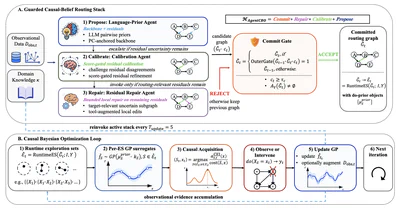
Causal Bayesian optimization (CBO) typically relies on the unrealistic assumption of a perfectly known causal graph. Recent methods relax this constraint by coupling optimization with structure learning, but they often waste sample budgets on structural uncertainties that are irrelevant to the optimizer. In this paper, we formalize routing-equivalence to shift the objective from full causal-graph recovery to causal belief routing, where structural differences only matter when they alter optimizer-facing objects such as admissible exploration sets and do-priors. We establish conditional fixed-update decision preservation and quantify CEI stability under predictive perturbations on a common exploration-set family. Furthermore, we propose AgentCBO, a graph-belief routing framework that incorporates LLM causal priors through guarded proposal and commit mechanisms. Specifically, a Language-Prior Agent combines LLM beliefs with constraint-based discovery to extract a protected causal backbone alongside residual uncertain edges. A Calibration Agent and a Residual Repair Agent then refine only these uncertain structures through score-gated bounded local edits. Finally, a deterministic commit gate evaluates candidate updates using routing-proxy checks before allowing them to influence intervention selection. Across ten benchmarks, AgentCBO performs comparably to known-graph CBO, demonstrating that guarded LLM priors can improve fixed-budget CBO performance.
We propose AgentCBO, a causal belief routing framework that brings LLM causal priors into causal Bayesian optimization through guarded proposal and commit mechanisms, performing comparably to known-graph CBO across ten benchmarks.
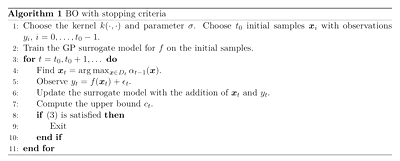
Bayesian optimization (BO) is a widely used iterative black-box optimization method that utilizes Gaussian process (GP) surrogate models. In practice, BO is typically terminated after a fixed evaluation budget is exhausted, which can incur unnecessary cost and provides no optimality guarantee on solution quality. Recent research in developing a practical stopping criterion has made empirical progress, yet a theoretically sound stopping criterion remains a work in progress. In this work, we present provably tighter instantaneous regret bounds for GP upper confidence bound (GP-UCB) at any given iteration. Then, we propose stopping criteria for GP-UCB based on this tighter bound that ensures an $\epsilon$-optimal solution with high probability $1-\delta$ upon termination. Numerical experiments are performed to validate and demonstrate the effectiveness and efficiency of our stopping criteria.
We propose theoretically sound stopping criteria for GP-UCB based on tighter instantaneous regret bounds, ensuring an $\epsilon$-optimal solution with high probability upon termination.
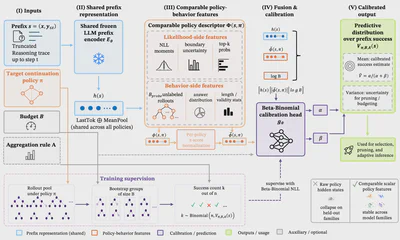
Inference-time scaling of LLM reasoning relies on a confidence score over each partial trace, yet existing estimators treat prefix quality as intrinsic to the prefix. A given prefix can succeed at very different rates and rankings under different continuation policies. Reasoning confidence is therefore not policy-invariant, and a squared-loss lower bound shows that policy-blind predictors retain residual error proportional to cross-policy disagreement. Calibration must condition on the continuation model and inference budget. To bridge this gap, we propose the Comparable Policy-Conditioned Calibrator (CPCC), built from a shared frozen-LLM prefix encoder, comparable scalar policy features under per-policy z-score normalization, and a Beta–Binomial head trained on bootstrap success counts. Across six continuation policies and three reasoning benchmarks (GSM8K, SVAMP, MATH-500), all evaluated under majority-vote aggregation, the CPCC family attains the lowest Brier on every evaluation cell, and CPCC is strongest on the held-out model families. It also avoids the held-out-family collapse of raw-hidden conditioning, lowers ECE by 13 to 26 percent on out-of-distribution math, and reduces downstream selective risk by 10 to 30 percent.
We show that reasoning confidence is not policy-invariant and propose CPCC, a policy-conditioned calibrator of prefix success that attains the lowest Brier score across six continuation policies and three reasoning benchmarks.
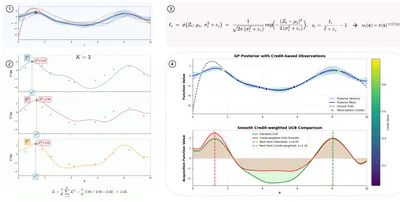
While traditional Bayesian Optimization (BO) often focuses on building a globally accurate surrogate model (e.g., via Gaussian processes) to represent the entire objective function, practitioners are frequently more interested in identifying the global optimum as quickly as possible. The authors argue that it is often inefficient to treat all historical observations as equally important for this specific goal. To address this, we introduce Counterfactual Credit Guided Bayesian Optimization (CCGBO), a framework that uses 'counterfactual credit' to explicitly quantify the contribution of individual historical observations to the discovery of the optimum. By incorporating these counterfactual credit scores into the acquisition function, the model can more effectively allocate sampling resources toward regions where the global optimum is most likely to reside. We prove that CCGBO maintains sublinear regret and demonstrate through empirical evaluations on both synthetic and real-world benchmarks that the method accelerates convergence to the global optimum compared to standard baselines.
We introduce CCGBO, a Bayesian Optimization framework that uses counterfactual credit to quantify historical observations' contribution to discovering the optimum, accelerating convergence.
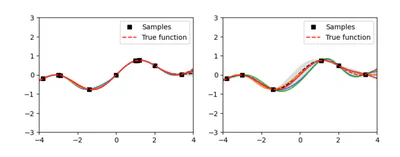
Standard Bayesian Optimization (BO) typically relies on Gaussian Process (GP) surrogate models. Because fitting a GP has $O(n^3)$ computational complexity (where $n$ is the number of data samples), BO becomes difficult to scale to large-budget scenarios. In this work, we propose a gradient-based sample selection (GSSBO) method designed to improve the computational efficiency of BO. Instead of using the entire dataset to fit the GP, the model is constructed using only a selected subset of samples. These samples are chosen by leveraging gradient information to eliminate redundancy while maintaining the diversity and representativeness of the dataset. Theoretical analysis in the paper provides explicit sublinear regret bounds for the framework. Experimental results on both synthetic and real-world tasks indicate that the method significantly reduces GP fitting costs while maintaining performance comparable to baseline methods.
We propose GSSBO, a gradient-based sample selection method that scales Bayesian Optimization to large-budget scenarios by selecting a representative subset of historical observations based on gradient information.
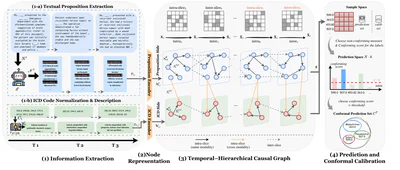
THCM-CAL (Temporal-Hierarchical Causal Modelling with Conformal Calibration) is a research framework designed for automated clinical risk prediction using electronic health records (EHRs). It addresses the challenge of predicting clinical risks by integrating two distinct data modalities found in EHRs: structured diagnostic codes and unstructured narrative notes. The framework constructs a causal graph where nodes represent clinical entities from both modalities. Unlike previous methods that treat these modalities separately or use simple fusion, THCM-CAL models directional, hierarchical causal interactions, inferring three types of clinically grounded interactions: intra-slice same-modality sequencing, intra-slice cross-modality triggers, and inter-slice risk propagation. To improve the reliability of predictions, the model incorporates conformal prediction for multi-label ICD coding, calibrating confidence intervals for individual codes. Experimental results on MIMIC-III and MIMIC-IV datasets demonstrate the effectiveness of THCM-CAL.
We propose THCM-CAL, a temporal-hierarchical causal modeling framework with conformal calibration for clinical risk prediction from structured and unstructured electronic health records.
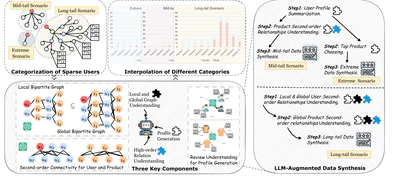
This paper addresses the challenge of data sparsity in sentiment analysis for streaming user reviews on e-commerce platforms. Traditional methods often treat reviews as static, independent data points, failing to capture the temporal evolution of user sentiments and the relationships between users and products. The authors identify three types of data sparsity that hinder sentiment modeling in streaming environments: temporal sparsity, spatial sparsity, and combined sparsity. To address this, we propose SynGraph, a dynamic Graph-LLM synthesis framework. The framework classifies users into three categories—mid-tail, long-tail, and extreme—based on their interaction patterns and engagement levels to better address their specific sparsity challenges. SynGraph employs a Continuous-Time Dynamic Graph (CTDG) to represent the evolving sequence of user-product interactions and incorporates Large Language Models (LLMs) to synthesize richer user and product representations, helping to alleviate the data gaps inherent in sparse scenarios.
We propose SynGraph, a dynamic Graph-LLM synthesis framework that mitigates data sparsity in streaming sentiment analysis using Continuous-Time Dynamic Graphs and LLM-augmented representations.
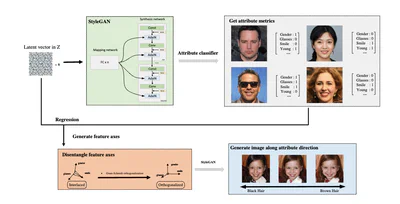
In this study, we propose a novel approach to synthesize high-resolution and hyper-realistic face images with controlled attributes. Firstly, by training an attribute classifier to assign attribute labels to given synthesized face images, we build the links between latent vectors and face attributes. Secondly, we adapt the regression method to match the distributions of latent vectors with the corresponding face attributes, to control the attribute synthesis in the face images. Finally, we use the Gram-Schmidt orthogonalization algorithm to disentangle the attribute feature axes in latent space, such that a change in one attribute will not cause any changes in other attributes. Extensive experiments demonstrate the effectiveness of the proposed approach for high-quality face image synthesis with controlled attributes.
We propose a face synthesis approach that controls facial attributes by matching latent vectors to attributes and disentangling the attribute feature axes in latent space with Gram-Schmidt orthogonalization.
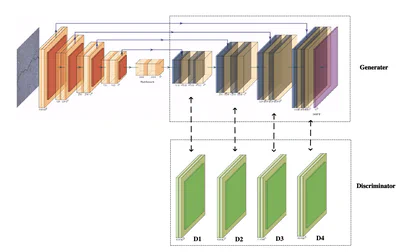
In recent years, the field of intelligent transportation has witnessed rapid advancements, driven by the increasing demand for automation and efficiency in transportation systems. Traffic safety, one of the tasks integral to intelligent transport systems, requires accurately identifying and locating various road elements, such as road cracks, lanes, and traffic signs. Semantic segmentation plays a pivotal role in achieving this task, as it enables the partition of images into meaningful regions with accurate boundaries. In this study, we propose an improved semantic segmentation model that combines the strengths of adversarial learning with state-of-the-art semantic segmentation techniques. The proposed model integrates a generative adversarial network (GAN) framework into the traditional semantic segmentation model, enhancing the model's performance in capturing complex and subtle features in transportation images. The effectiveness of our approach is demonstrated by a significant boost in performance on the road crack dataset compared to the existing methods, SEGAN. This improvement can be attributed to the synergistic effect of adversarial learning and semantic segmentation, which leads to a more refined and accurate representation of road structures and conditions. The enhanced model not only contributes to better detection of road cracks but also to a wide range of applications in intelligent transportation, such as traffic sign recognition, vehicle detection, and lane segmentation.
We propose a deeply supervised semantic segmentation model built on a GAN framework, improving road crack segmentation over existing methods such as SEGAN.
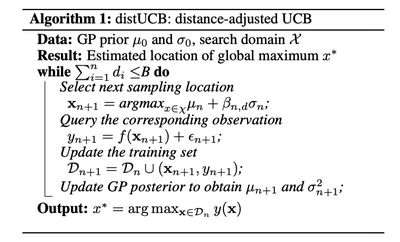
Bayesian Optimization (BO) has recently received increasing attention due to its efficiency in optimizing expensive-to-evaluate functions. For some practical problems, it is essential to consider the path-dependent switching cost between consecutive sampling locations given a total traveling budget. For example, when using a drone to locate cracks in a building wall or search for lost survivors in the wild, the search path needs to be efficiently planned given the limited battery power of the drone. Tackling such problems requires a careful cost-benefit analysis of candidate locations and balancing exploration and exploitation. In this work, we formulate such a problem as a constrained Markov Decision Process (MDP) and solve it by proposing a new distance-adjusted multi-step look-ahead acquisition function, the distUCB, and using rollout approximation. We also provide a theoretical regret analysis of the distUCB-based Bayesian optimization algorithm. In addition, the empirical performance of the proposed algorithm is tested based on both synthetic and real data experiments, and it shows that our cost-aware non-myopic algorithm performs better than other popular alternatives.
We formulate Bayesian optimization with path-dependent switching costs as a constrained MDP and propose distUCB, a distance-adjusted multi-step look-ahead acquisition function with a theoretical regret analysis.
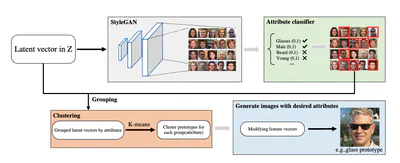
Recent advances in deep neural networks, especially in generative adversarial networks (GAN), have shown remarkable progress in face image generations. However, most of the existing face image generators can only synthesize random face images, but are not able to control the attributes of the generated face images. Though conditional GAN based methods can manipulate the attributes to some extent, but can only generate low-resolution face images up to $256\times 256$. In this study, based on StyleGAN, one of the state-of-the-art image generators for synthesizing high-quality face images, we propose a simple but efficient approach to generate high-resolution and hyper-realistic face images with any desired attribute. By training an attribute classifier to assign attribute labels to given synthesized face images, we build the links between latent vectors and face attributes. In such a way, the latent vectors can be grouped into different clusters, one cluster corresponding to one face attribute, respectively. We then extract the prototypes for the clusters, which are used to control the attribute of the generated face image. Extensive experiments demonstrate the effectiveness of the proposed approach for high-quality face image generation with predefined attributes.
We propose a StyleGAN-based approach that groups latent vectors by face attribute and uses the cluster prototypes to generate high-resolution face images with desired attributes.